
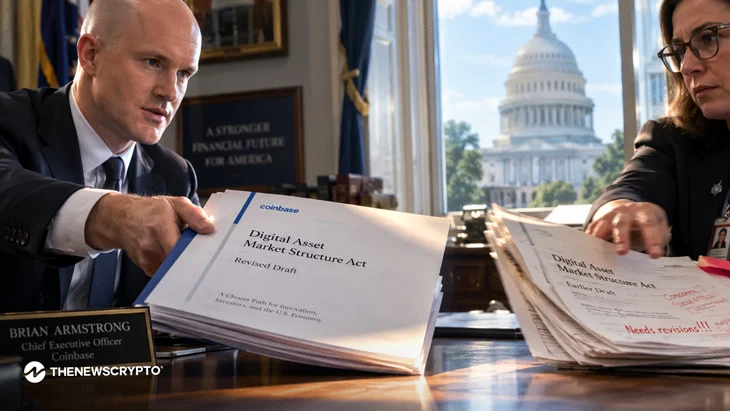
- Coinbase CEO Brian Armstrong denies responsibility for the CLARITY Act failing in the Senate and claims the Wall Street Journal is preparing an article to pin the blame on him.
- Armstrong explained that although Coinbase rejected the January draft, the company backed the updated bill once lawmakers resolved its primary shortcomings.
Brian Armstrong, CEO of Coinbase, has issued a preemptive response to an upcoming piece by The Wall Street Journal that he contends will target him and his company for the Senate’s failure to advance the CLARITY Act.
“Here we go again!” Armstrong stated via a post on X. He mentioned that the WSJ is “working on a story blaming Coinbase and me personally for the CLARITY Act not passing,” while also accusing the publication of maintaining a consistently hostile stance against the bill.
Furthermore, Armstrong defended Coinbase’s choice to push back against a prior draft of the legislation in January, pointing out that the initial text contained significant flaws regarding stablecoin rewards, DeFi, tokenization, and CFTC authority.
“At the time, the bill had major issues that would have harmed crypto,” Armstrong noted. He additionally claimed that support among lawmakers was fractured and that the legislation was not ready to pass.
According to Armstrong, Coinbase subsequently collaborated with lawmakers and other stakeholders to revise the proposal. He noted that all four issues he highlighted in January were successfully resolved by the time the text reached the Senate Banking Committee roughly four months afterward.
“The final draft of CLARITY that went to the Senate was great, and I strongly supported it,” Armstrong wrote.
What Led Coinbase to Oppose the Bill
The disagreement centers on the evolution between the version Coinbase objected to in January and the text that was subsequently revised.
Back in January, Coinbase pulled its backing for the draft that was queued for a Senate Banking Committee markup. The panel had scheduled a consideration of the bill on January 15, but the markup was delayed after Coinbase raised concerns.
Armstrong characterized that January draft as a “de facto ban on tokenized equities,” while expressing worries regarding CFTC spot-market jurisdiction, penalties targeting DeFi developers, and limitations on stablecoin rewards.
Following that, the legislation underwent months of discussions involving regulators, industry participants, and senators.
During early May, senators Angela Alsobrooks and Thom Tillis finalized a compromise concerning stablecoin rewards. The updated text banned rewards functionally or economically similar to bank-deposit interest, while permitting specific rewards connected to legitimate platform usage.
Armstrong greeted the agreement with a brief directive: “Mark it up.”
By a 15-9 vote on May 14, the updated bill cleared the Senate Banking Committee. Coinbase maintained its backing for the legislation thereafter, including sections addressing anti-money-laundering rules, consumer protections, self-custody, SEC and CFTC jurisdiction, and digital-asset classifications.
On September 15, the legislation ultimately failed to pass in the Senate. Lawmakers voted 49-50 against proceeding, falling short of the 60 votes necessary for the procedural hurdle. Following the tally, Armstrong labeled the outcome disappointing and asserted that the CFTC and SEC could still formulate crypto regulations utilizing their pre-existing authority.
In a separate interview conducted recently, Armstrong stated that the Senate treated Coinbase’s early criticisms as feedback and amended the bill. He asserted that the four problematic areas were corrected in the final version and blamed the bill’s defeat on separate disagreements.
Armstrong described the result as “a missed opportunity for the US to lead.”
His remarks bring attention back to the distinction between the January draft and the bill that ultimately faced a Senate vote. While Coinbase rejected the initial proposal, it later supported the amended legislation after lawmakers modified the contested clauses.
Highlighted Crypto News:
a16z-Backed Linera Shuts Down Operations as Funding Runs Dry
Frequently Asked Questions
Why did Coinbase oppose the initial CLARITY Act draft in January?
Coinbase opposed the January draft due to major issues involving tokenized equities, stablecoin rewards, CFTC spot-market authority, and penalties directed at DeFi developers.
Did Coinbase support the final version of the bill?
Yes. After months of negotiations addressed Coinbase’s earlier concerns, Armstrong stated that the final draft sent to the Senate was great and that he strongly supported it.
Why did the CLARITY Act ultimately fail in the Senate?
The bill failed to reach the required 60 votes on September 15, resulting in a 49-50 vote against advancing it. Armstrong attributed the failure to other disagreements among lawmakers.