

- DogeOS has launched its public testnet, introducing EVM-compatible smart contracts to the Dogecoin network.
- Transaction fees are paid in DOGE, and creators can now develop gaming, stablecoin, trading, and DeFi applications using DogeOS.
The DogeOS project has launched its public Chikyū testnet, introducing an EVM-compatible smart contract layer to the Dogecoin ecosystem via a zero-knowledge rollup.
Debuting on September 30, the testnet provides a testing ground for developers to construct applications on Dogecoin without altering the foundational Layer 1 network. On DogeOS, DOGE serves as the native currency for gas and transaction fees.
This release grants Dogecoin creators access to Ethereum-compatible smart contract architecture. Developers can leverage standard toolsets like Remix, Foundry, and Hardhat, with the Chikyū testnet currently running on chain ID 6281971.
DogeOS Brings DeFi and Other Applications to Dogecoin
DogeOS aims to enable use cases previously unsupported on Dogecoin’s native layer, such as lending protocols, decentralized exchanges, prediction markets, perpetual trading, games, and stablecoins. Early builders already testing on the network include Barkswap, USDoge, Superposition Finance, Split Markets, and Derps.
Targeting a throughput of roughly 300 transactions per second—up from Dogecoin Layer 1’s standard 30 transactions per second—DogeOS utilizes a separate application layer to execute smart contract operations independently of Dogecoin’s core consensus rules.
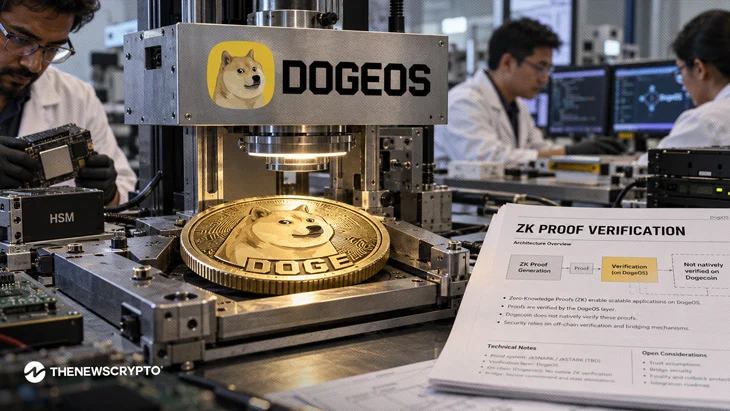
While the zero-knowledge rollup aims to settle its state onto Dogecoin, Dogecoin does not yet natively verify these zero-knowledge proofs. Instead, the testnet relies on a permissioned sequencer, validators, and a trusted execution environment, requiring valid proofs alongside TEE and validator signatures for bridge state transitions.
Although DogeOS has previously pitched a Dogecoin Core protocol upgrade that would enable direct verification of ZK proofs on the base layer, that update has not yet been adopted.
Consequently, the near-term impact for DOGE centers on application utility rather than core protocol alterations. Users can spend the cryptocurrency on smart contract transaction fees, and developers gain an EVM-compatible framework for crafting Dogecoin-focused apps.
No official mainnet release date has been set by DogeOS. The active public testnet is intended for developers to build and trial applications ahead of any eventual mainnet deployment.
CoinMarketCap records from the time of publication indicate that DOGE was trading near $0.0976 on October 1, marking an increase of about 2.5% over the preceding 24 hours.
Frequently Asked Questions
What is DogeOS?
DogeOS is a platform that brings an EVM-compatible smart contract layer to the Dogecoin ecosystem using a zero-knowledge rollup.
When did the DogeOS testnet launch?
The public Chikyū testnet officially went live on September 30.
What token is used for transaction fees on DogeOS?
DOGE functions as the native token for covering transaction fees on the network.
What is the target transaction speed for DogeOS?
The network aims for approximately 300 transactions per second, compared to the roughly 30 transactions per second found on Dogecoin’s Layer 1.
Has a mainnet launch date been announced?
No mainnet release date has been scheduled yet by DogeOS.