

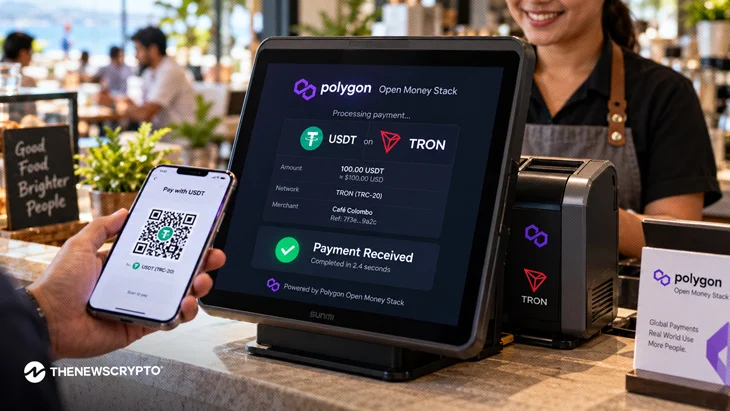
- Polygon Open Money Stack now supports TRON, enabling enterprises to handle USDT deposits, wallets, payouts, and cross-chain transfers through a single integration.
- TRON accounts for over $94 billion in circulating USDT and boasts a cumulative transfer volume exceeding $30 trillion.
Polygon Labs has incorporated TRON into its Open Money Stack, empowering companies to construct payment solutions centered around USDT on TRON while linking those activities to traditional banking, cards, cash, and alternative blockchain ecosystems.
Unveiled on October 8, the integration permits organizations to execute complete stablecoin transaction pipelines—encompassing deposits, wallets, cross-chain movements, and payouts—via the Open Money Stack. This development grants payment platforms, exchanges, remittance providers, and fintechs direct access to more than $94 billion of circulating USDT on the TRON network.
Consequently, enterprises can accept incoming funds via fiat mechanisms like bank transfers, credit cards, and cash, or through cryptocurrency, subsequently converting traditional currency into TRC-20 standard USDT on TRON. Furthermore, firms can safeguard holdings in embedded or custodial wallets, transfer assets seamlessly between TRON and compatible chains, and disburse payouts to crypto addresses, bank accounts, cards, or physical cash outlets.
According to Polygon, this update is tailored for commercial entities whose client bases already rely on TRON for holding and moving USDT. Rather than forcing users to migrate funds elsewhere, organizations can seamlessly maintain TRON within their current transaction workflows.
TRON USDT Connects With Cross-Chain and Fiat Rails
Polygon’s infrastructure simultaneously introduces cross-chain routing capabilities. Companies can transfer supported tokens between TRON and EVM-compatible networks seamlessly, sparing end-users from navigating separate wallet applications or standalone bridges.
When handling incoming funds, the Open Money Stack generates dedicated TRON addresses for users, automatically linking incoming USDT transfers to the correct user account. Businesses can subsequently oversee these balances and distribute capital according to operational needs.
In parallel, Polygon’s pre-existing fiat framework supplies essential on- and off-ramp services. The organization notes that its money-transmitter licenses span 48 U.S. states, helping eligible firms bridge blockchain-derived assets with legacy financial infrastructure.
Data referenced by Polygon from TRONSCAN indicates that the TRON network has surpassed $30 trillion in total transaction volume, alongside more than 407 million user accounts and 15 billion processed transactions. Additionally, TRON maintains over $28 billion in total value locked.
Polygon emphasized that the TRON integration is built for companies seeking an all-in-one suite for wallets, deposits, payouts, and cross-chain functionality without the burden of developing each component independently.
Frequently Asked Questions
What is the Polygon Open Money Stack?
It is an infrastructure toolkit provided by Polygon Labs that allows businesses to build payment products, manage stablecoin wallets, handle deposits and payouts, and connect blockchain transactions with fiat rails.
How does the TRON integration benefit businesses?
It enables companies to interact with the more than $94 billion in circulating USDT on TRON, letting them process deposits, execute cross-chain transfers to EVM networks, and manage payouts without building separate payment modules.
Are fiat transactions supported?
Yes. Polygon’s money-transmitter licensing covering 48 U.S. states provides on- and off-ramp capabilities, allowing businesses to connect blockchain funds with traditional banking, credit cards, and cash.
What are some key metrics for the TRON network?
According to figures cited from TRONSCAN, TRON has processed over $30 trillion in cumulative transaction volume, recorded more than 407 million accounts, handled 15 billion transactions, and holds over $28 billion in total value locked.