


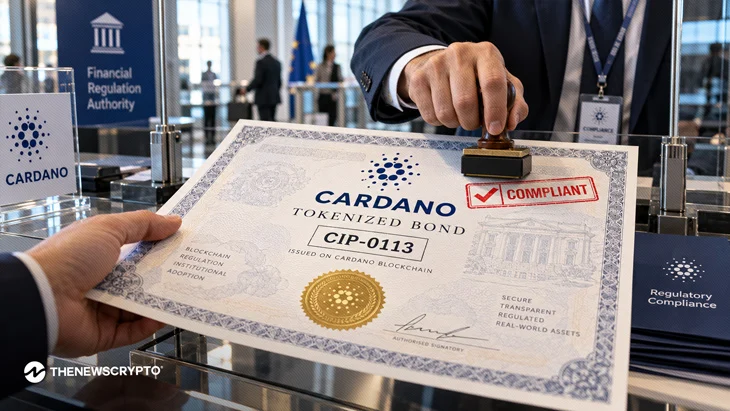
- The CIP-0113 programmable token standard has officially debuted on the Cardano mainnet, featuring ledger-enforced compliance capabilities.
- Issuers can utilize this standard to integrate compliance regulations—such as anti-money laundering (AML), know-your-customer (KYC), and transfer limitations—into tokenized and regulated assets.
The Cardano Foundation has rolled out its new programmable token standard, known as CIP-0113, onto the Cardano mainnet. This deployment provides creators with a mechanism to embed compliance policies right into tokens created for regulated financial instruments.
Revealed on October 7 during the TOKEN2049 event, the standard empowers issuers of stablecoins, bonds, tokenized funds, and other regulated instruments to enforce regulations involving sanctions screening, KYC and AML checks, transfer restrictions, and freeze-and-seize functionalities. These stipulations are directly executed by the Cardano ledger during token burning, minting, or transfers.
Cardano’s programmable token standard, CIP-0113, is live on mainnet.
Issuers of stablecoins and other regulated assets can now build compliance rules directly into native Cardano tokens.
Enforced by the network itself. No hard fork required. https://t.co/J6WKo1G6bI— Cardano Foundation (@Cardano_CF) October 7, 2026
Operating on Cardano’s extended UTXO architecture, CIP-0113 functions without needing any hard fork. Assets minted via this framework function as native Cardano tokens instead of wrapped iterations of current assets. Creators have the option to choose from modular rule frameworks or author custom compliance logic, with the flexibility to modify these rules as legal guidelines evolve.
The Foundation highlighted that the standard was crafted alongside Cardano community participants and reached the mainnet following a series of independent security evaluations. Initial ecosystem collaborators backing the launch comprise BloxBean, GeroWallet, Eternl, and CardanoScan.
CIP-0113 Gains Recognition From Swiss Market Association
Simultaneously with the mainnet rollout, the Cardano Foundation together with the Swiss Capital Markets and Technology Association (CMTA) shared that CIP-0113 Programmable Asset Tokens are now acknowledged as a smart-contract equivalent to CMTAT under the CMTA certification program.
According to the Foundation, CIP-0113 incorporates the mandatory capabilities outlined in the CMTAT framework, making it potentially useful for verifying compliance for ledger-based equity securities according to CMTA guidelines. This recognition seeks to aid Swiss ledger-based securities, cut down on due-diligence demands, and preserve a chain-agnostic strategy.
Furthermore, the Foundation intends to persist in collaborating with institutions and projects leveraging the standard, which includes ongoing work on a securities module tailored for regulated financial assets.
This release does not imply that all tokens on Cardano will inherently possess compliance measures. These directives exclusively govern assets minted under the CIP-0113 standard, leaving specific controls entirely up to individual issuers.
Frequently Asked Questions
What is Cardano’s CIP-0113?
CIP-0113 is a programmable token standard launched on the Cardano mainnet that lets issuers embed compliance rules—such as KYC, AML, and transfer restrictions—directly into regulated tokenized assets.
Does CIP-0113 require a hard fork on Cardano?
No, CIP-0113 is built on Cardano’s extended UTXO model and does not require a hard fork to operate.
Are all tokens on Cardano automatically compliant now?
No. Compliance controls only apply to assets specifically issued using the CIP-0113 standard, and individual issuers decide which controls to attach to their tokens.
When was CIP-0113 announced?
The standard was announced on October 7 at TOKEN2049.