
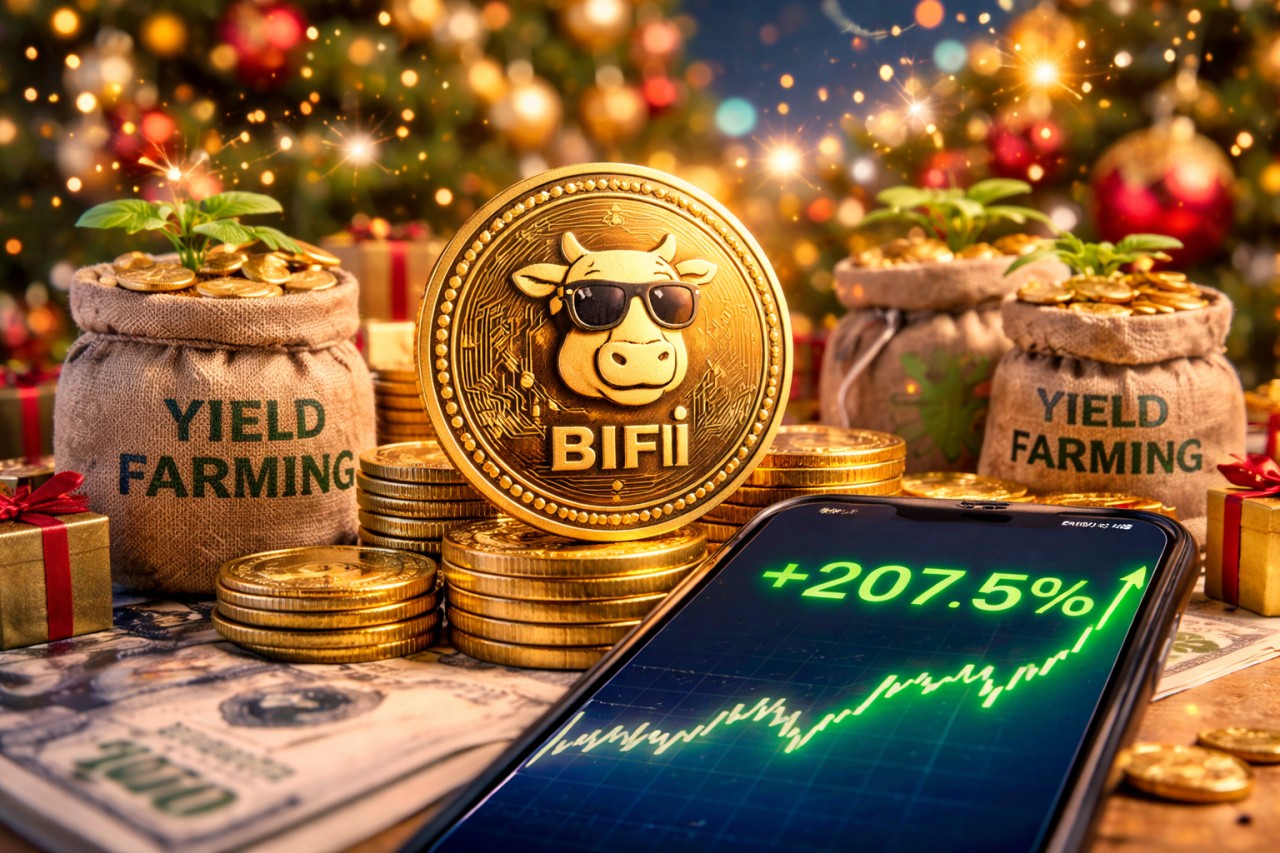
Crypto traders aren’t exactly known for taking holidays. Still, even by their restless standards, Christmas Day’s surge of BIFI, DeFi’s original yield token, was spectacular. As most of the world was carving turkeys and exchanging gifts, screens across trading desks from Dubai to Singapore were lighting up green. By late evening, Beefy Finance’s BIFI token had soared more than 200%, posting its strongest single-day rally since early 2021.
For a token that spent much of the year drifting quietly under the radar, the move jarred even veteran DeFi watchers.
The ghost of DeFi Christmas past
Beefy Finance isn’t new. Launched in the height of the “yield farming summer” back in 2020, the protocol was one of the first multi-chain yield aggregators, essentially a platform that automates the art (and math) of compounding DeFi returns.
At its peak, BIFI was priced above $3,000 per token. Then came two years of malaise: shrinking volumes, risk aversion, and fading enthusiasm for speculative yield. By mid-2024, the token traded below $400, its community small but stubbornly loyal.
Then came this week.
A 200% move and no obvious catalyst
When BIFI began climbing early on December 25, many shrugged it off as low-liquidity holiday volatility. But as the rally stretched past midday and volume ballooned across Binance and Bybit, traders realized something bigger was brewing.
Within hours, BIFI had more than tripled, briefly touching $1,280 before cooling. Daily trading volume topped $480 million, ten times its monthly average. Funding rates for perpetual futures spiked.
And yet, there was no dramatic announcement, no influencer campaign, no partnership leak to explain the frenzy.
Instead, on-chain analysts traced the trigger to a mix of organic whale accumulation and protocol migration news trickling through DeFi Telegram channels. A few days prior, Beefy had announced cross-chain expansion plans into Blast, zkSync, and Base, along with a revised tokenomics proposal that would route more platform revenue directly toward BIFI stakers.
“Traders had been ignoring Beefy for months,” said DeFi strategist Nilesh Tamang. “Now suddenly they realized the protocol’s TVL is up 40% quarter-over-quarter, it’s multi-chain, and it’s actually generating fees. Combine that with thin holiday liquidity, and you get fireworks.”
Flashbacks to DeFi’s early mechanics
There’s also nostalgia baked into this rally. BIFI was among the last of the original yield aggregator lineups still alive under its founding architecture. For DeFi’s old guard—the ones who remember manually harvesting LP tokens on PancakeSwap and AutoFarm, Beefy’s resilience holds cultural weight.
Its treasury currently manages more than $950 million in total value locked (TVL) across 20+ chains, a rare feat for a protocol that avoided major security incidents or governance blow-ups. That credibility, in a year when trust became the new alpha, suddenly seems to have caught up to price.
“BIFI’s rally says less about hype and more about how undervalued real yield protocols became,” said Laura Parsons, a senior analyst at Delphi Digital. “It’s a reminder that sustainable cashflow in DeFi can still excite markets, even in a mature phase.”
Real yield narrative meets holiday liquidity
The rally also fits into a larger rhythm running through late December’s markets, a sector rotation into real-yield DeFi plays while speculative tokens cool. Platforms like Convex, Pendle, and Lido have all posted double-digit gains this month as investors rotate toward protocols with steady fee income.
That rotation intersected perfectly with thin liquidity over the Christmas weekend. “When there’s low activity, a few whales can ignite a full-blown squeeze,” one trader wrote in a Discord channel. “And once bots smell that volume, it’s self-fulfilling.”
The irony? Crypto’s “real yield” narrative, once marketed as boring, has turned into one of 2025’s most explosive trades.
Behind the euphoria, a cautious optimism
Not everyone is buying the euphoria. Some analysts warned that BIFI’s dramatic surge looked unsustainable and would likely retrace once liquidity normalizes. Others pointed to high slippage and the possibility of short-term profit rotations into other yield protocols.
But even skeptics admit something about this rally feels different from the empty pumps of past years. The fundamental backdrop looks sturdier, the traders more seasoned. Yield platforms like Beefy are now woven into the infrastructure of DeFi cross-chains, serving as yield routers for treasuries, DAOs, and stablecoin vaults.
“Beefy’s still a mid-cap compared to the giants like Lido or Aave,” Parsons said. “But its run shows where sentiment is drifting, toward old protocols that survived, adapted, and stayed functional.”
The day DeFi woke up again
By the evening of December 25, as the price started consolidating around $1,050, social media feeds turned sentimental. Memes of Santa riding DeFi charts replaced market angst. A few jokingly called it “the Christmas DeFi resurrection,” others just posted screenshots of reborn portfolios.
In a market where narratives come and go faster than the cookies left out for Santa, BIFI’s rally might fade in a week. Or maybe it marks something quieter, the slow return of faith that rural survivors of the last cycle can still carry DeFi’s next one.
Either way, it made for one hell of a Christmas rerun.